Four laboratory workflows
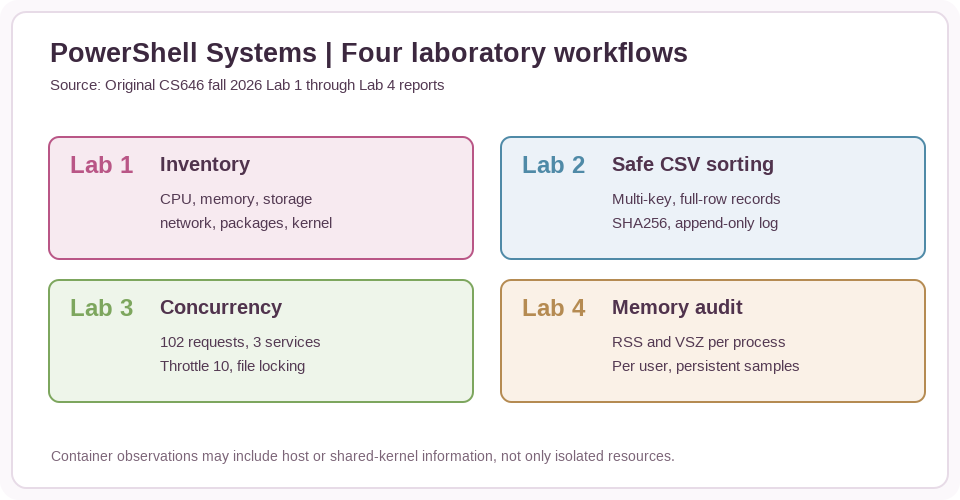
The work moved from observing a Linux container to preserving CSV records, coordinating shared resources and tracking process memory.
CS646 · Fall 2026 · Operating systems coursework
Inventory, safe CSV processing, and synchronized parallel tasks
ENGINEERING EVIDENCE / AT A GLANCE
Audit system resources and coordinate concurrent tasks without corrupting shared data.
Implemented four CS646 lab workflows: inventory, CSV sorting, bounded concurrency and memory auditing.
PowerShell 7, Debian, CSV/SHA256, file locking, parallel tasks, procfs and cgroups.
Used hash checks, synchronized-counter experiments, timed serial/parallel workflows and memory snapshots as reported.
Reported 300,000-row sort: 10.04 versus 7.19 s; 102 requests: 8.69 versus 1.68 s; unlocked counter 2 versus locked 100.
Historical report values were not rerun; several original scripts, datasets and raw logs are missing.
Across four CS646 operating-systems labs, I used PowerShell in a Debian Linux course container to inspect system resources, protect whole CSV records, coordinate bounded concurrent work, and audit memory by process and user. All four original lab reports survive, and the original memory-audit.ps1 script was recovered. Other scripts and raw datasets remain unavailable; new reference examples are labeled separately.
OPERATING SYSTEMS / LAB EVIDENCE
The original four CS646 reports document inventory, safe sorting, bounded concurrency and repeatable memory auditing. The visualizations below reproduce only reported summary results or explain known memory and OS concepts; no historical raw log or performance trace was fabricated.
The work moved from observing a Linux container to preserving CSV records, coordinating shared resources and tracking process memory.
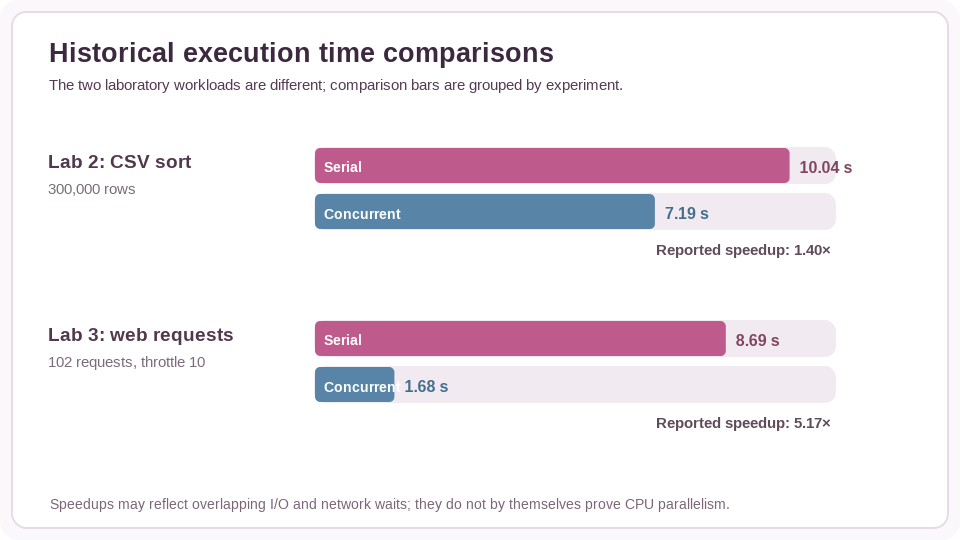
A 300,000-row sort took 10.04 versus 7.19 seconds. A separate 102-request HTTP task took 8.69 versus 1.68 seconds.
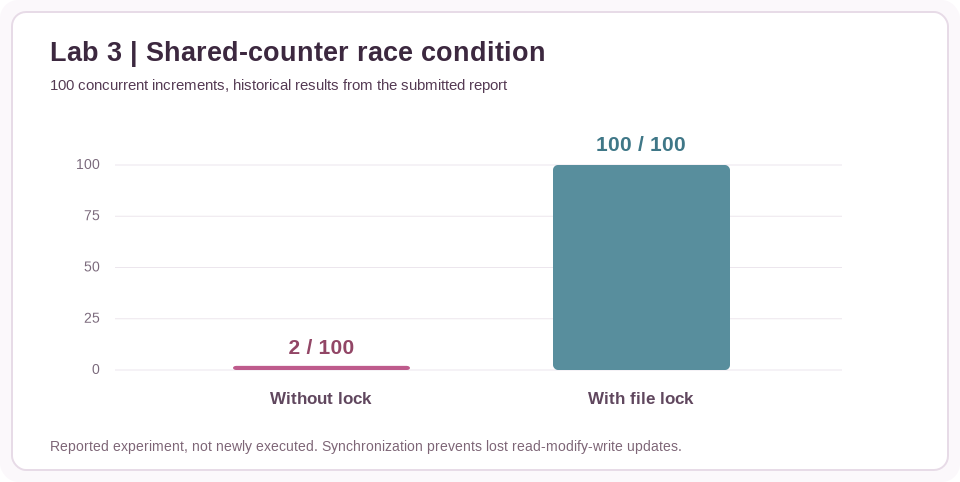
The reported 100-increment counter lost updates without file locking, returning 2 rather than the expected 100. With locking it finished at 100.
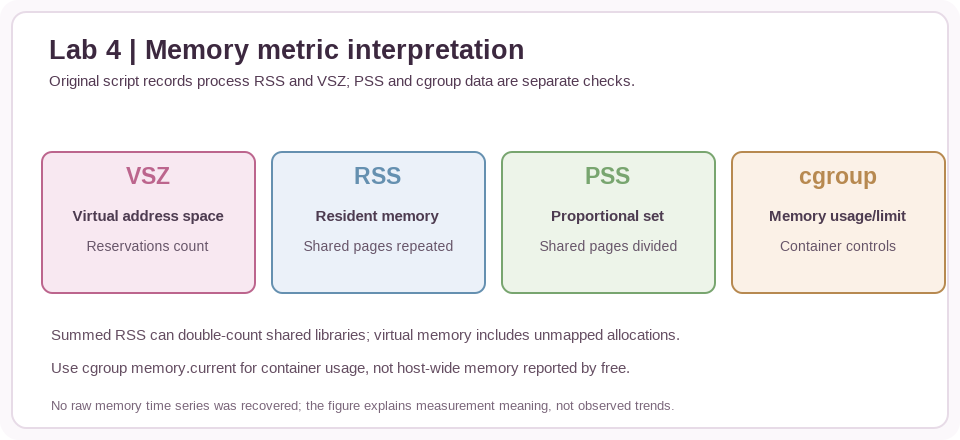
The recovered original memory-audit script records RSS and virtual memory by process and user. The source report separately investigates PSS and cgroup limits.
Build scripts that behave correctly in a container, preserve input integrity, and safely coordinate shared resources.
Inspect Linux process, CPU and cgroup interfaces; sort whole CSV records while verifying input hashes; run 102 reported requests across three hosts with a throttle limit of 10 and synchronized logs; collect periodic RSS and VSZ observations by process and user.
PowerShell 7, Debian Linux, containers, CSV, SHA256, ForEach-Object -Parallel, file locking, strace, ps and cgroup/procfs accounting.
Lab 2 recorded 300,000-row CSV sorting in 10.04 seconds (standard) and 7.19 seconds (parallel), an independently recalculated 1.40× reported speedup. Lab 3 recorded 102 requests across three services in 8.69 seconds serially versus 1.68 seconds concurrently (5.17× reported speedup). A 100-increment shared-counter experiment ended at 2 without synchronization and 100 with locking. Lab 4 documented periodic memory collection; the original memory-audit.ps1 source has now been recovered. All timings and race outcomes are historical report values, not newly rerun experiments.
Original Lab 1–4 reports underpin the historical values, and the Lab 4 memory-audit source is preserved. Reports, screenshots, raw CSVs, missing Labs 1–3 scripts and original performance logs remain unpublished. The new computational examples and ten passing synthetic checks do not establish fresh PowerShell or OS benchmarks.