GitHub · Lighting control

DMX Controller

A browser interface connected to physical lights

ENGINEERING EVIDENCE / AT A GLANCE

What was done, checked, and documented

Problem

Translate browser scene and brightness selections into RGBW DMX frames.

My contribution

Original browser/Flask and Arduino source documents the control system; exact individual module ownership is not recorded.

Engineering tools

Flask, Python, serial, Arduino Mega, DMX/RS-485 and RGBW control.

Validation method

Inspected recovered code and calculated frame timing/dimming outputs; video offers context only.

Documented result

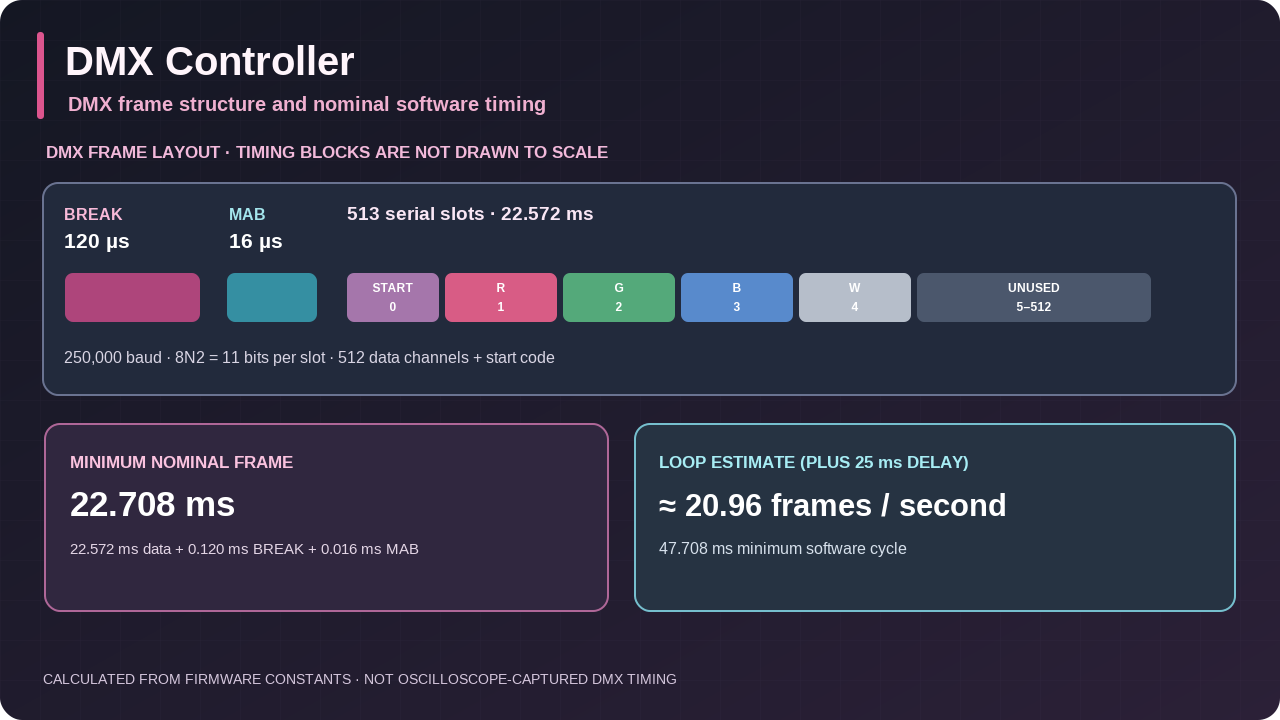
Four RGBW slots, programmed scenes and a 22.708 ms calculated minimum frame at 250 kbit/s.

Limitations

No oscilloscope-verified waveform, physical fixture measurements or authenticated HTTP control.

PROJECT 15 / 16

This project brings a familiar browser interface to a hardware lighting-control problem. Choosing a scene or brightness setting produces commands for an Arduino-based DMX system.

Engineering details

Challenge

Translate simple user controls into real output for RGBW lighting hardware.

Approach

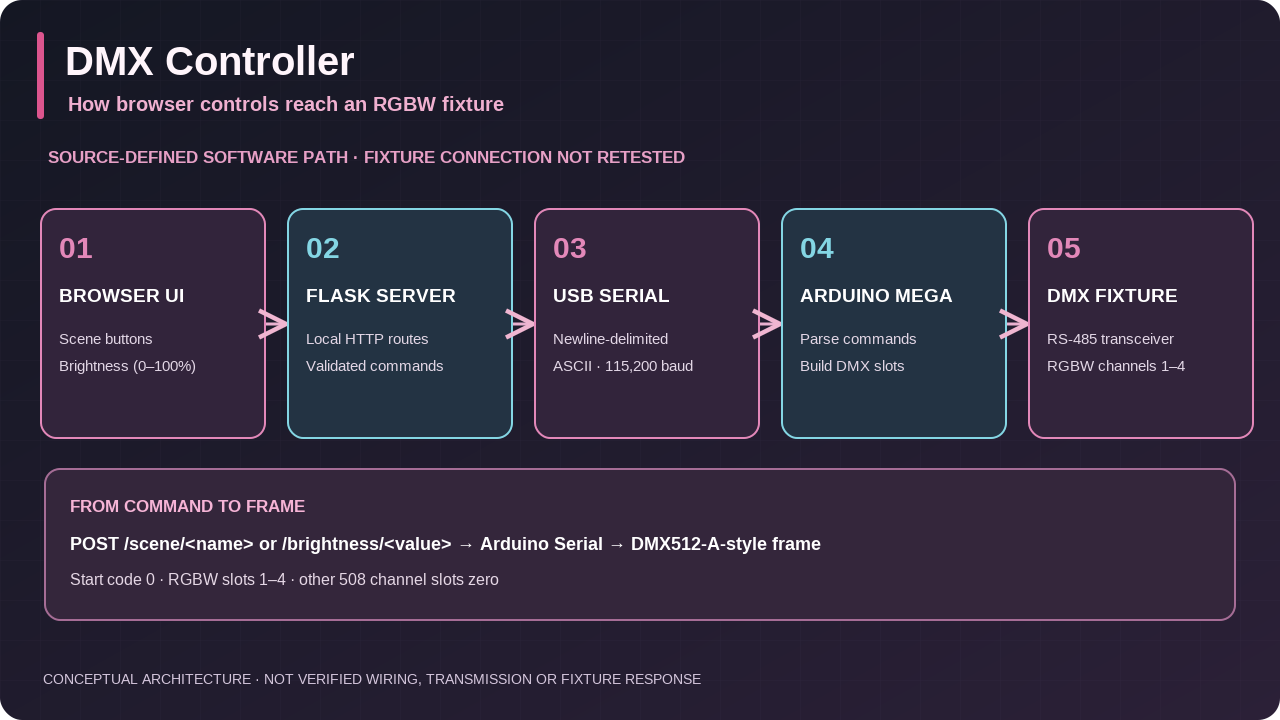
Use Flask to receive browser inputs and send serial commands to Arduino for DMX output.

Tools

Python, Flask, Arduino, serial communication, DMX.

Recovered lighting-control system

The original Flask interface and Arduino Mega sketch are available in GitHub. The controller sends newline-delimited serial commands at 115,200 baud, and the firmware constructs DMX frames with a zero start code and four RGBW data channels. The original sketch's invalid fconst declaration was corrected; the Flask service now listens on localhost by default. The existing demonstration video is preserved, but physical DMX timing and fixture response have not been retested in this recovery.

Recovered engineering and verification

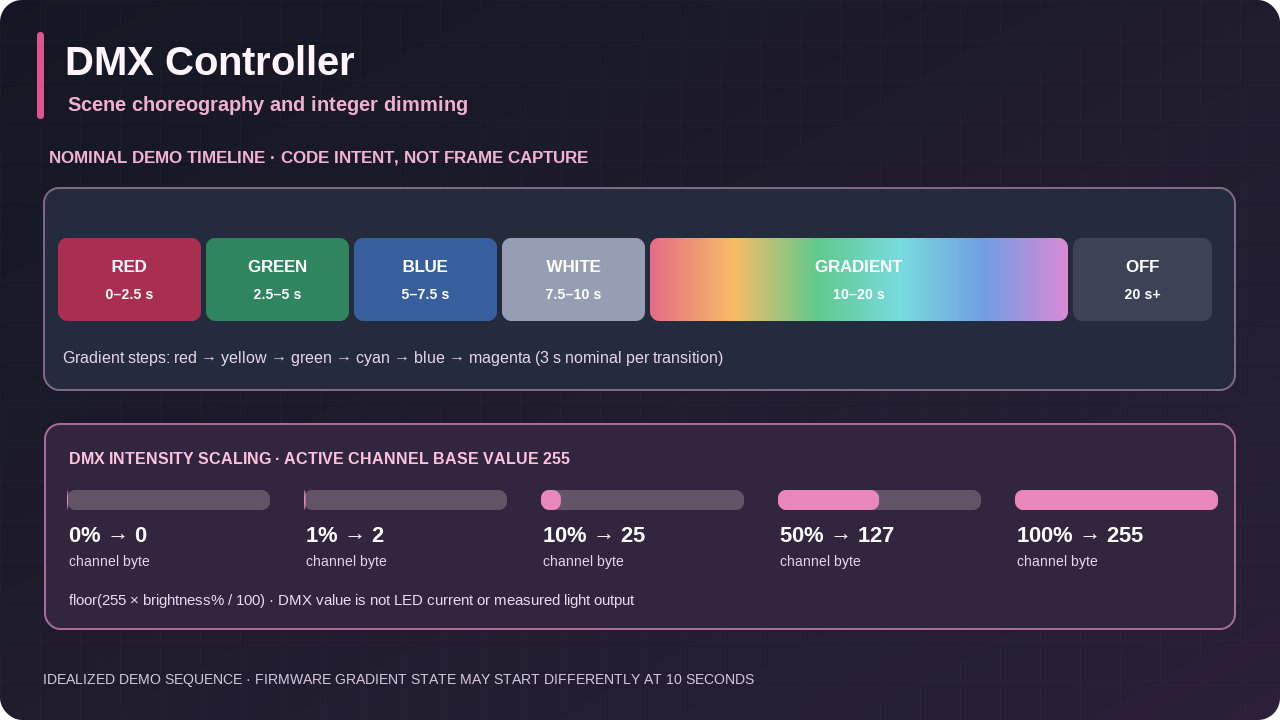
The source describes seven scene commands, dimming from 0% to 100%, a six-color gradient, and a 20-second nominal demonstration timeline. An independent offline reference model and 13 synthetic tests check the channel assignment, integer dimming, scene sequencing and timing calculations. Arduino compilation, physical signal integrity, luminaire channel mapping and current ratings require a subsequent hardware test. The original HTTP endpoints do not authenticate users, so the recovered app should remain local-only unless explicitly secured.
Evidence & limitations

Evidence boundary: Source inspection and offline synthetic tests establish the intended control logic only. Arduino compilation, RS-485 wiring, electrical DMX timing, output channel order, fixture response and lighting safety require hardware checks. No proprietary logs, raw measurements or source downloads are included on this page.