Lighting demonstration
Original portfolio demonstration footage; not an accuracy or fixture-qualification test.
GitHub · Human interaction
Turning hand gestures into lighting responses
ENGINEERING EVIDENCE / AT A GLANCE
Control RGBW lighting scenes through stabilized webcam-recognized gestures.
Documented gesture-to-scene work and later recovered policy logic; individual ownership of original modules is not separately established.
JavaScript, MediaPipe, webcam, Node.js bridge and Casambi lighting scenes.
Source inspection and 11 synthetic offline behavior checks of timing, mappings and state handling.
Eight source-defined scenes and a reconstructed policy model with 11 offline tests.
No newly verified camera recognition rate or physical lighting performance; bridge has no request authentication.
HueMotion explores what happens when a familiar action becomes an interface. By interpreting hand gestures from a webcam, the project connects human movement to responsive RGBW lighting.
GESTURE CONTROL / VISUAL CASE STUDY
The original video and source-derived diagrams show gesture recognition, RGBW scene mapping and timing safeguards. These visuals do not independently verify recognition accuracy or fixture output.
Original portfolio demonstration footage; not an accuracy or fixture-qualification test.
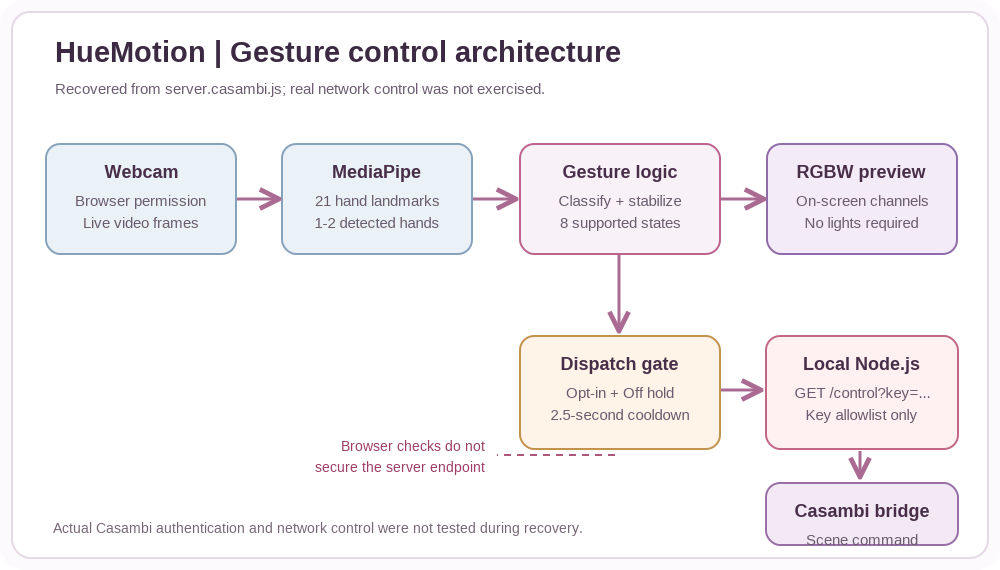
Architecture recovered from the public browser and optional local bridge source.
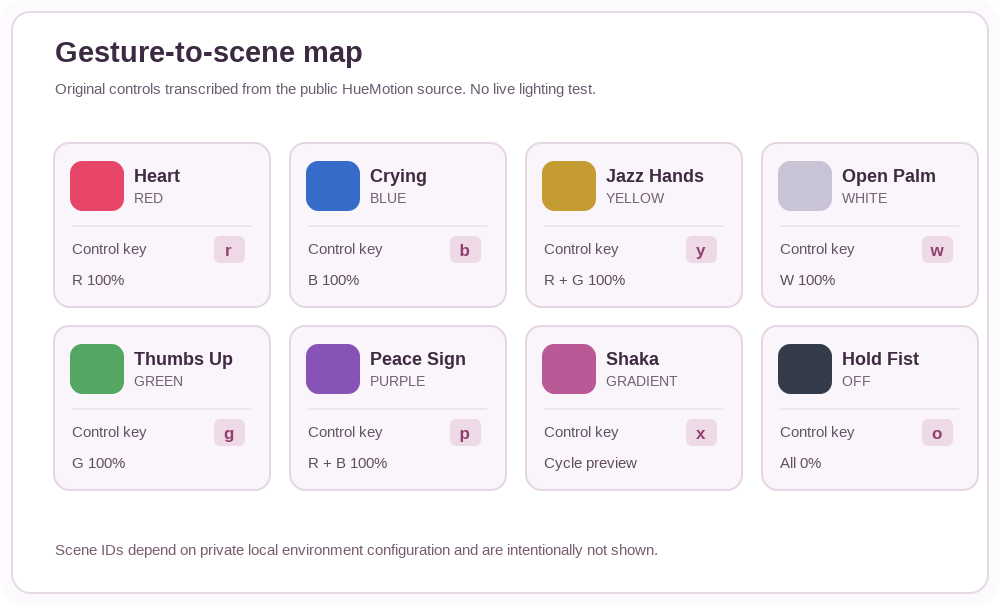
Source-documented gestures and their corresponding lighting-scene previews.
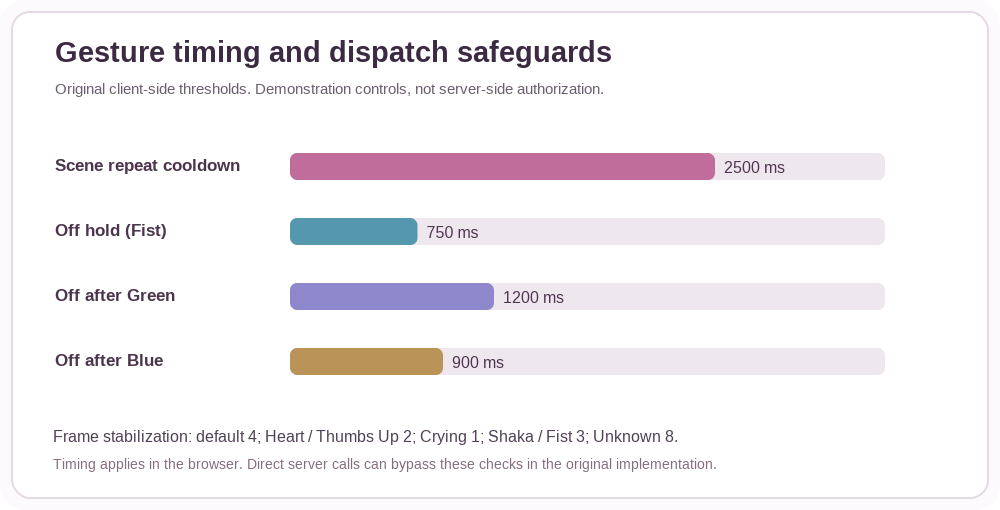
Browser-side timing logic designed to reduce repeated activation.
Make gesture recognition useful for controlling lighting in an intuitive way.
Track hands with MediaPipe and map gesture states to lighting controls and a browser preview.
JavaScript, MediaPipe, Node.js, webcam tracking, RGBW lighting.
The original source and manual are still available. A browser uses MediaPipe hand landmarks, custom gesture classification, frame-based stabilization, and an RGBW preview. An optional local Node.js bridge maps eight approved keys to configured Casambi lighting scenes. The recovered software's functionality is established by source inspection; live camera accuracy and physical lighting response have not been independently retested.
I reconstructed the gesture-state and scene policy as a separate offline JavaScript module and verified 11 synthetic behavior cases. The recovery package includes source architecture, frame thresholds, timing rules, eight scene mappings and a security review. The original HTTP /control endpoint does not authenticate callers, so the bridge must be secured before exposure on an untrusted network or use in a real deployment.
The recovered architecture, gesture mapping and offline tests describe source-level behavior. Live webcam classification accuracy and physical lighting response were not independently retested; the local control bridge must be secured before exposure to untrusted networks.